

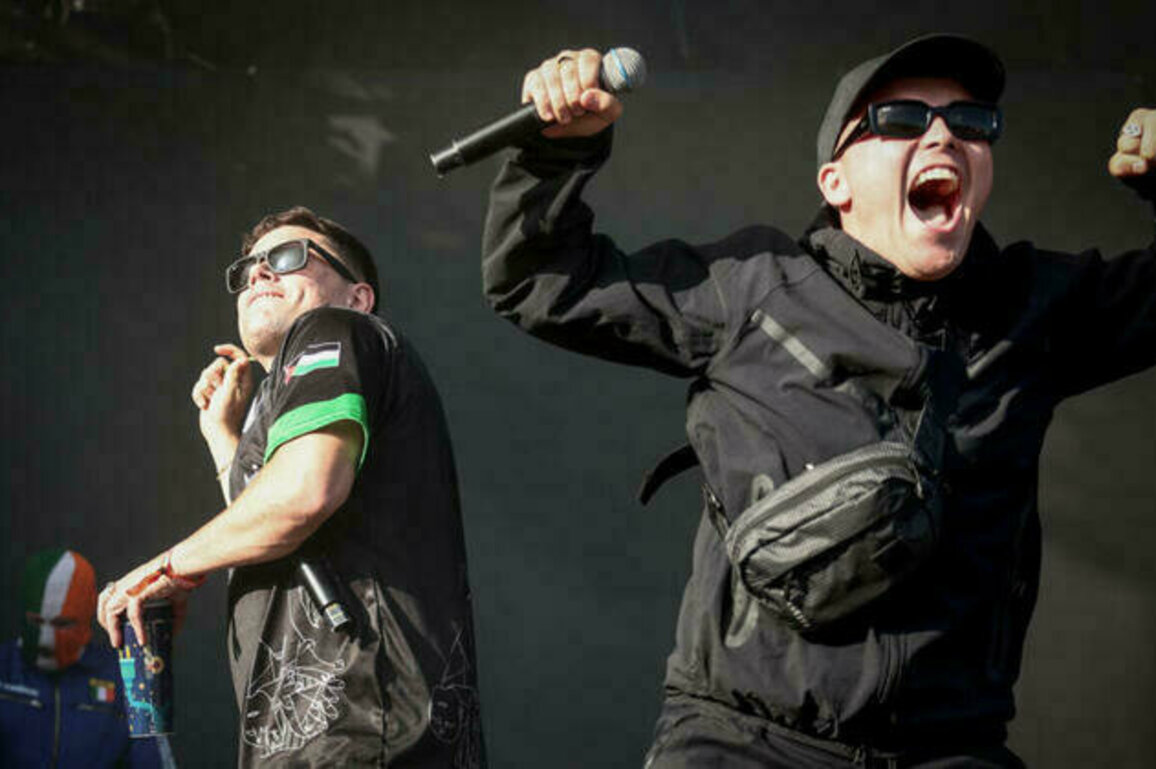
A UK judge on Friday ruled that Liam O'Hanna, a member of the Irish rap group Kneecap who was charged with a terrorism offence in May, would no longer face proceedings because the six-month limit usually fixed for such charges had expired. OHanna was told he was free to go as supporters in court cheered.
A London court on Friday threw out a terrorism case against a member of provocative Northern Irish rap group Kneecap over a technical error.
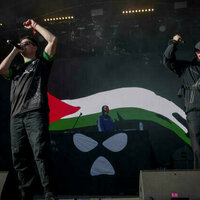
Liam O'Hanna, 27, was accused of displaying a flag of the Iran-backed Lebanese militant group Hezbollah at a gig, but judge Paul Goldspring ruled the "proceedings against him were instituted unlawfully and are null" and told him he was "free to go", to cheers from his supporters in court.
Goldpsring ruled thatO'Hanna was charged after the six-month limit to bring such a charge, which can only be dealt with by the magistrates' court.
"The charge is unlawful and null and this court has no jurisdiction to try the charge," the judge said to cheers from the public gallery.
O'Hanna was initiallycharged in May.
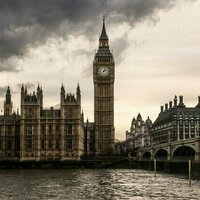
His legal team has challenged whether the charge was filed within a six-month time limit, with a decision expected at Westminster Magistrates' Court in central London.
Supporters are set to flock to the area again for the 10am hearing, as hundreds did in August in a noisy, highly visible show of solidarity.
Read moreIrish rap group Kneecap play Paris concert despite Gaza protest controversy
"Come and show your support outside Westminster Magistrates Court," the band posted on X earlier this week, branding the legal process a "witch-hunt".
Butthey warnedthat the Metropolitan Police had now set a new route and had "removed our supporters from anywhere close to the court entrance. This is petty in the extreme"."There is no basis for this, both our last hearings were entirely peaceful and a loving show of solidarity," the band added.
Since the UK banned Hezbollah as a terrorist organisation in 2019, it has been an offence to show support for the group.
O'Hanna has denied wrongdoing, saying in previous interviews that he did not know what the Hezbollah flag was, and that he is part of a sometimes satirical musical act not to be taken at face value.
Kneecap has also said the video that led to the charge was taken out of context.
In an interview with AFP earlier this month, O'Hanna predicted the charge was "clearly going to get thrown out, because it's ridiculous".
The raucous punk-rap group, who sing in the Irish language as well as English, has also issued a statement saying "they do not, and have never, supported Hamas or Hezbollah".
They have seen their notoriety increase since the start of the legal proceedings, having been banned inCanadaandHungary, with some of their concerts cancelled inGermanyandAustria.
The group cancelled all 15 dates of a planned US tour next month, because they fell too close to the court case.
Palestine Action arrests
Kneecap has grabbed headlines for statements denouncing Israel's war in Gaza.
The UK legal case comes amid growing controversy over support for banned organisations.
Hundreds have been arrested, mostly at demonstrations, since thePalestine Action groupwas outlawed in early July under anti-terrorism laws.
Read moreWhat is Palestine Action, the protest movement banned under UK terror act?
The government ban on Palestine Action came into force days after it took responsibility for a break-in at an air force base in southern England that caused an estimated 7 million of damage.
The group said its activists were protesting Britain's military support for Israel duringthe Gaza war.
Supporting a proscribed group is a criminal offence punishable by up to 14 years in prison in the UK.
Daring provocateurs to their fans, dangerous extremists to their detractors, Kneecap was formed in 2017 and is no stranger to controversy.
Its lyrics are filled with references to drugs, members have repeatedly clashed with the UK government, and they have vocally opposed British rule in Northern Ireland.
Last year, the group was catapulted to international fame by a semi-fictional film based on them that scooped multiple awards, including at the Sundance festival.
(FRANCE 24 with AFP and Reuters)
Originally published on France24